What are the downsides of Profhilo?
What are the disadvantages of Profhilo? Almost everyone considering it asks that question, and it is a good one. You are having an injection in your face and you pay per session.
The honest answer has two parts that seem to contradict each other. Serious problems are rare with Profhilo, and there are figures to support that. Mild reactions in the first few days, however, are very common: in clinical research, roughly half of participants notice something on the skin. And the downside that causes the most disappointment is not about side effects at all, but about what Profhilo does not do
Table of contents
- The short answer
- Downside 1: almost half notice something in the first few days
- Disadvantage 2: the result is temporary
- Downside 3: Profhilo does not add volume or lift anything
- Downside 4: you only see the result after several weeks
- Downside 5: most of the research comes from the manufacturer
- When Profhilo is not suitable
- If the result disappoints you: Profhilo can be dissolved
- How to reduce the risk of side effects
- Do the downsides outweigh the result
- Frequently asked questions
- Personalised advice
- Sources
The short answer
Profhilo has five real disadvantages. During the first few days, you may have small bumps, redness or bruising at the injection sites. The effect is not permanent, so you will need to come back. It adds no volume and lifts nothing, making it the wrong treatment for a sagging jawline or hollow cheeks. You will not see the result until several weeks later, not the next day. And most clinical research into the product has been paid for by the manufacturer, with small participant groups.
On the other hand, the safety figures are good. Serious complications are rare in practice. Below, we look at each downside and how significant it really is, including the figures.

Downside 1: almost half notice something in the first few days
There are two types of figures here, and the difference explains a lot.
The manufacturer keeps a worldwide record of adverse events reported by doctors. Between 9 February 2015 and 8 February 2018, an estimated 42,394 patients were treated. Twelve reports were received over those three years. The treating doctors described all of them as non-serious, and the patients recovered without lasting effects. The reports involved swelling, fluid, redness and bruising shortly after treatment, plus two later reactions involving swelling and bumps.
Twelve reports among more than 42,000 people sounds reassuring, and it is when it comes to serious problems. But the researchers themselves note that underreporting of minor incidents cannot be ruled out. No doctor reports a bruise that disappears after two days to a manufacturer.
Clinical research does take everything into account, and then the picture looks different. A 2026 systematic review combined nine studies with a total of 278 participants. On average, 46 percent of participants experienced a side effect, although the range between studies was wide, from 20 to 75 percent. Across the studies, the percentage reporting bruising ranged from 13 to 88 percent. Other reported effects were swelling in 7 to 8 percent, small bumps in 17 percent, local bruising in 12 percent and a mildly prickling sensation in 2 percent. All side effects were mild and disappeared within approximately 72 hours.
The two figures together give the honest picture: there is a real chance that you will see something during the first few days, roughly one in two. The chance that it is anything more than a bruise or a bump that disappears within three days is small.
The small bumps have a logical explanation, by the way. Profhilo is injected at five fixed points on each side of the face and then spreads beneath the skin on its own. In the hours afterwards, you can still feel and see the product sitting in those spots. This is normal and disappears on its own.
The Dutch Society for Dermatology and Venereology is clear about genuinely rare reactions. Its guideline on injectable fillers states that product-specific adverse reactions to hyaluronic acid are very rare (0.06 percent), and that allergic or other inflammatory reactions can occur in rare cases (0.4 to 0.5 percent). Rare does not mean impossible, and that is exactly what you should expect a clinic to tell you.
Disadvantage 2: the result is temporary
A face consists of four layers, and all four change: skin, fat, retaining ligaments and bone. When the jawline starts to sag, they change together.
The skin produces less collagen and elastin and consequently becomes looser than the structures beneath it. The fat compartments in the midface become smaller. On our own page about cheek filler treatments, you can read that this starts at around the age of thirty. The result is that the upper face loses fullness while weight shifts downward.
Then there are the retaining ligaments, strands of connective tissue that anchor the skin at fixed points to the underlying tissue. These weaken. The tissue then sags between the anchored points and bulges out there. That is why sagging cheeks do not appear as an even swelling, but as a bulge with a clear indentation in front of it.
And then there is the layer that almost nobody writes about.
Disadvantage 3: Profhilo adds no volume and lifts nothing
This is the disadvantage that causes the most disappointment, and it is rarely stated clearly anywhere.
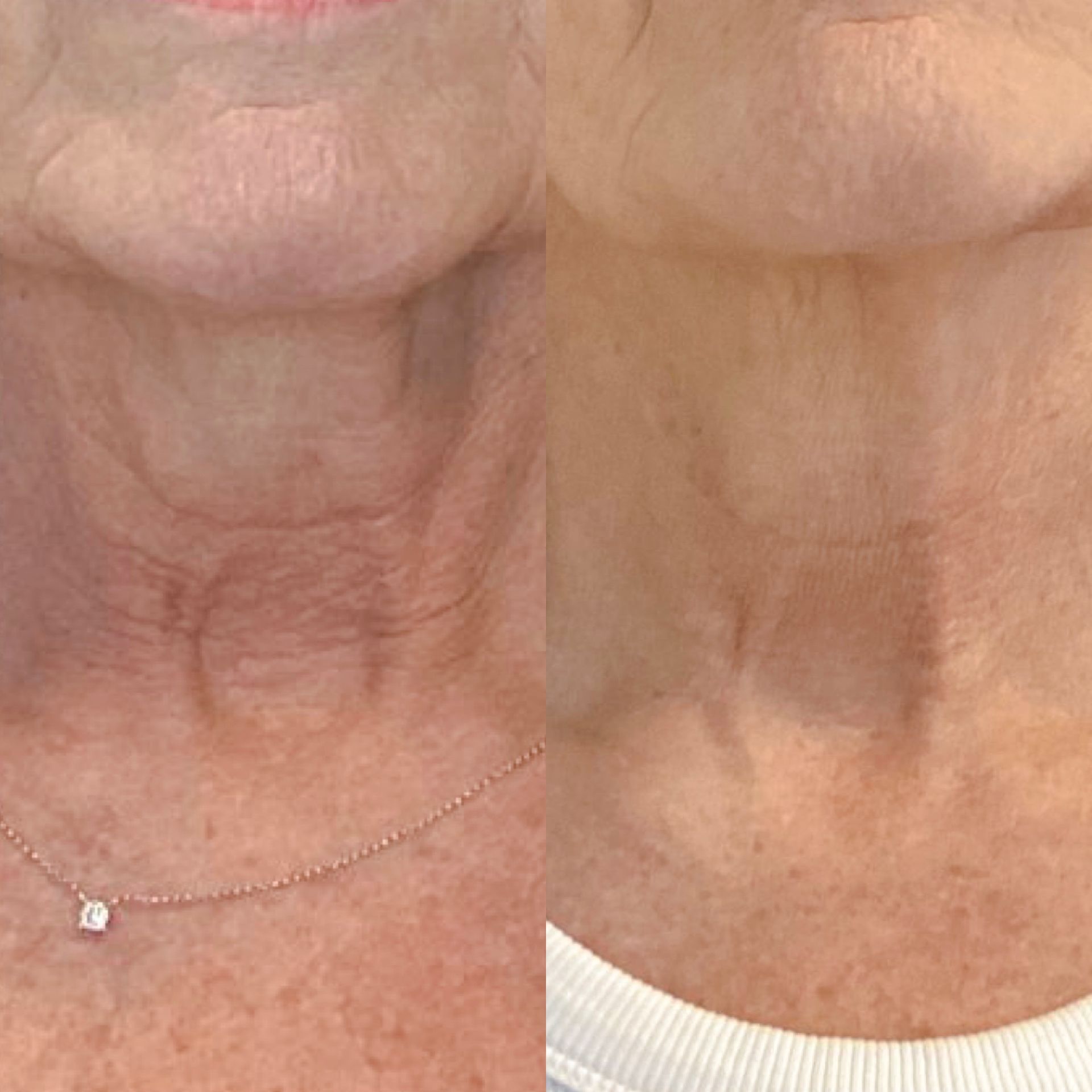
Profhilo improves the quality of the skin. Your skin becomes firmer, more supple and better hydrated, and fine lines become less visible. What does not happen: no volume is added and nothing is lifted. A filler does do that, because it provides shape.
If you recognise yourself in any of these points, Profhilo is probably not the treatment you are looking for:
- your cheeks have become hollow or flatter
- your jawline has become less defined and tissue is hanging over it
- you have deep folds running from your nose to the corners of your mouth
- your cheekbones are less prominent than they used to be
These are all questions of shape and support, and for those you need something else. For volume loss in the cheeks, for example, we use fillers or biostimulators, not a skinbooster. They do work well together: the filler provides the shape, while Profhilo improves the skin.
So if you read that Profhilo lifts your face, that is not correct. Your skin will look fresher and smoother, which often makes other people think you look more rested. That is different from a lift.
Disadvantage 4: you will not see it for weeks
If you have a treatment on Monday and expect to see the difference in the mirror on Tuesday, you will be disappointed. In the first few days, you mainly notice hydration: your skin feels softer and looks fresher. The full result takes four to six weeks after the course, because during those weeks your skin starts producing collagen and elastin itself.
Then factor in the course structure. The standard approach is two to three sessions about a month apart. From the first injection to the final result, you are therefore looking at two to three months at the very least. Do not schedule it two weeks before a wedding or photoshoot.
Disadvantage 5: most of the research comes from the manufacturer
You will not read this point at many clinics, but it belongs in an honest overview.
The 2026 systematic review we mentioned above brought together nine studies with a total of 278 participants. The researchers themselves identify several limitations. All the included studies took place at a single centre. Six had fewer than thirty participants. Only one study included men. The participants were predominantly white women, and the way the effect was measured differed between studies. In addition, the review itself was funded by IBSA Farmaceutici Italia, the manufacturer, and three of the authors are employees of that company. The same applies to the 2020 safety study.
What does that mean in practice? It does not mean that the results are inaccurate. It does mean that the evidence is less robust than the marketing suggests, and that there is less certainty about the effect than with a product tested in large groups by independent researchers. You deserve to know that before making a decision.
There is no ambiguity about the composition. One syringe contains 64 milligrams of hyaluronic acid in 2 millilitres: 32 milligrams with a long molecule and 32 milligrams with a short molecule, combined using heat rather than a chemical cross-linking agent.
When Profhilo is not suitable
The Dutch dermatologists’ guideline lists several situations in which an injectable filler should not be administered. Absolute reasons to avoid treatment include unrealistic expectations, body dysmorphic disorder or suspected body dysmorphic disorder, a known allergy to one of the ingredients, and being under eighteen for a cosmetic treatment.
There are also situations that require caution and assessment on a case-by-case basis: an autoimmune disease, an area where permanent fillers have previously been placed, an infection in or around the treatment area, pregnancy and breastfeeding.
That first point, unrealistic expectations, is at the top for a reason. Someone who expects a tighter jawline after one session will not get what they are looking for from Profhilo. It will not help you, and it will not help us either.
If the result disappoints you: Profhilo can be dissolved
A question that often goes unspoken: what if I regret it?
With Profhilo, the answer is reassuring. It consists of pure hyaluronic acid, and a doctor can dissolve hyaluronic acid using the enzyme hyaluronidase. The guideline also recommends this approach for problems with a hyaluronic acid filler. In practice, this is rarely necessary with a skin booster because no volume is placed that could result in asymmetry.
With PolyPhil using polynucleotides, it is different. Hyaluronidase works exclusively on hyaluronic acid, so it cannot dissolve that product. You then have to wait for the body to break it down on its own. Good to know if you are choosing between the two.

How to reduce the risk of side effects
You have some control over the likelihood of bruising.
- If you take blood thinners or anti-inflammatory medication, tell us in advance. Never stop medication prescribed by your doctor on your own initiative. Discuss it with them first.
- Do not drink alcohol the evening before. Alcohol dilates the blood vessels, making bruising more likely.
- Avoid exercise, saunas and sunbeds for the first few days.
- Do not massage or rub the injection sites for the first 24 hours.
- Do not schedule any important appointments during the first 48 hours.
But most of it is not down to you; it is down to the person performing the injections. Injection technique and the correct depth determine how your skin responds. The dermatology guideline therefore sets requirements for the practitioner: registration in the BIG register, knowledge of the different fillers, indications and contraindications, and injection techniques, as well as demonstrable competence in administering them. Feel free to ask about this during your consultation.
Do the downsides outweigh the result
That depends on what you want to achieve.
If you are looking for fresher, smoother skin with fewer fine lines and are happy to repeat the treatment once or twice a year, the disadvantages are easy to understand: a few days when you may have bruising and a recurring expense. The 2026 review concludes that the treatment combats laxity, improves the skin’s hydration, elasticity and density, and reduces wrinkles and facial volume loss.
If you are looking for shape, support or a lifting effect, the disadvantages matter because you would be paying for something you will not get. In that case, a consultation about what Profhilo can and cannot do for you is more useful than booking an appointment straight away.
Sources
| Subject | Sources |
|---|---|
| Contraindications, hyaluronic acid adverse-event rates (0.06 percent product-specific, 0.4 to 0.5 percent allergic or inflammatory reactions), duration of effect 6 to 12 months, hyaluronidase and practitioner requirements. | Guideline on Injectable Fillers, Dutch Association for Dermatology and Venereology (accessed August 2026). |
| 42,394 patients treated between 9 February 2015 and 8 February 2018, 12 reported adverse events, none serious, plus the composition of 64 mg of hyaluronic acid per 2 ml. | Cassuto et al., Safety Assessment of High- and Low-Molecular-Weight Hyaluronans (Profhilo) as Derived from Worldwide Postmarketing Data, BioMed Research International 2020, PMID 32685528. |
| Nine studies, 278 participants, an average adverse-event rate of 46 percent, bruising in 13 to 88 percent, bumps in 17 percent, resolution within approximately 72 hours, and the limitations of the evidence. | Sparavigna et al., A Systematic Review of the Efficacy and Safety of Profhilo and Profhilo Body, Plastic and Aesthetic Nursing 2026, volume 46 issue 2, PMID 41920062. |
| Prices, number of sessions, duration of six to nine months and the five injection points on each half of the face. | Cosmopolitan Clinic Amsterdam's own treatment pages (accessed August 2026). |
Frequently asked questions
Is Profhilo dangerous?
The available figures point to a favourable safety profile. An estimated 42,394 patients were treated over three years, during which twelve adverse events were reported. None was serious, and all patients recovered without lasting effects. Mild reactions such as bruising are common, however. Very rare allergic or inflammatory reactions cannot be ruled out.
How long do bruises and bumps last after Profhilo?
In the clinical research, the reported side effects disappeared within approximately 72 hours. The small bumps at the injection sites usually disappear within a day, because the product spreads beneath the skin. If something lasts longer than a week, please contact us.
Can Profhilo be dissolved?
Yes. Profhilo consists of pure hyaluronic acid, and a doctor can dissolve it with hyaluronidase. This is rarely necessary with a skin booster because no volume is placed.
Does Profhilo work equally well for everyone?
No. How your skin responds depends on your age, the condition of your skin, smoking and sun damage. In addition, the research has mainly been conducted in white women and only one study included men, so less is known about other groups.
I still cannot see anything after one treatment. Is that normal?
Yes. After the first session, you mainly notice hydration. The full result appears four to six weeks after the final session of the course, and a course consists of two to three sessions approximately one month apart.
Personalised advice
If you are unsure whether Profhilo is right for your skin and your goals, simply ask us. During a consultation, our BIG-registered doctors assess your skin and will also tell you if a skinbooster will not deliver what you are looking for. That is a more reassuring starting point than undergoing a treatment that disappoints you afterwards. Book a no-obligation consultation in Amsterdam.