Nasolabial fold filler treatment in Amsterdam
The folds between the nose and corners of the mouth, known as nasolabial folds or smile lines, are often the first signs of ageing in the face. At Cosmopolitan Clinic in Amsterdam, we soften them with filler, first assessing what is causing the fold before injecting anything. Below, you can read how the treatment works, why simply filling the fold is not always the best approach, what the risks are and how much it costs.
Table of contents
- What is the nasolabial fold?
- How the fold forms
- Why simply filling the fold is often not enough
- How does filler treatment work?
- The treatment step by step
- Results and how long they last
- Recovery and aftercare
- Risks and side effects
- Who is the treatment suitable for?
- How much does the treatment cost in Amsterdam?
- Frequently asked questions
- Personalised advice in Amsterdam
What is the nasolabial fold?
The nasolabial fold runs from the side of the nose to the corner of the mouth. It is known medically as the nasolabial fold and commonly as a smile line. Everyone has one, even at a young age, because the fold marks the boundary between your cheek and upper lip. Without it, smiling would look odd.
So it is not about the fold itself, but how deep it appears when your face is at rest. If the crease is visible when you are not making an expression, that is when people want to do something about it.
Don’t confuse these with the smile lines around your eyes. These are crow’s feet, and they require a completely different treatment: a wrinkle relaxer, not filler.
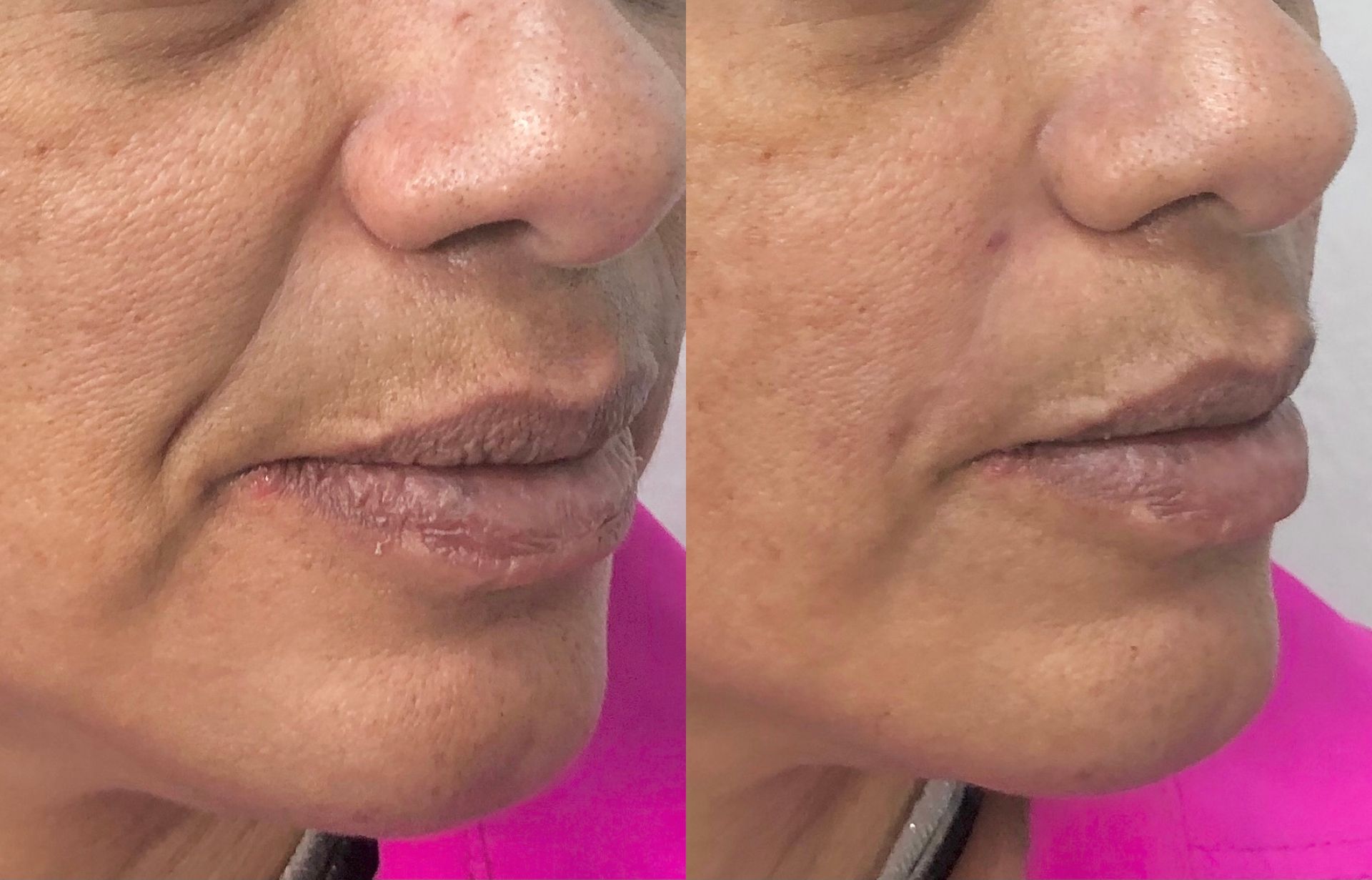
How the fold forms
Repeated muscle movements such as smiling and talking make these wrinkles deeper. Loss of volume beneath the skin also makes the folds more visible. Deep folds can make you look tired.
There’s a third factor behind those two causes, and it determines the approach. The fatty tissue in your cheeks is divided into compartments, which gradually descend with age. They accumulate above the fold, making the edge above it heavier and the crease look deeper. The fold itself isn’t necessarily etched deeper; it’s being overshadowed from above.
Why simply filling the fold is often not enough
Treatment is often combined with treatment of the cheekbones for the best results. This isn’t a sales pitch; it follows from how the fold forms.
If the problem is mainly the fold itself, filling the crease works well. If the depth is mainly due to sagging in the midface, filling the fold merely fills in a shadow caused by the area above it. The result is then modest, and using too much product can make the area around the mouth look heavy and unnatural.
In that case, it is better to restore volume in the cheekbones or the cheek first. This lifts the edge above the fold again and softens the crease naturally. Usually, much less filler is then needed in the fold itself, and sometimes none at all.
That’s why our doctor always assesses the entire midface first, rather than just the line you point to. The recommendation may be different from what you expected.
How does filler treatment work?
Filler treatment can soften and reduce the depth of nasolabial folds. Sometimes the fold can almost disappear completely. This depends on how deep the lines are and varies from person to person.
We use hyaluronic acid-based fillers. Hyaluronic acid is a substance that your body also produces and that binds moisture. The filler fills the crease and supports the surrounding skin, making the shadow in the fold less pronounced.
Two properties are important here. Hyaluronic acid is gradually broken down by the body, so the result is temporary and changes slowly along with your face. It is also dissolvable: if you are unhappy with the result or a problem arises, a doctor can dissolve it using hyaluronidase. This reversibility is one of the reasons we use hyaluronic acid in this area.

The treatment step by step
- We start with a consultation. The doctor assesses your entire midface at rest and in motion, not just the fold.
- We’ll explain what’s likely to have the greatest effect in your case: treating the fold itself, the cheek area, or both.
- The area is cleansed. Our fillers contain a local anaesthetic, and an anaesthetic cream can be applied beforehand on request.
- The doctor injects the filler using a fine needle or cannula. The filler is applied slowly and in small amounts, with regular checks of the skin’s blood circulation.
- The treatment takes about fifteen to thirty minutes.
The result is visible immediately. The area may remain somewhat swollen for the first few days, making it look fuller at first than the final result.
Results and how long they last
You will see the result immediately after treatment. The final result will be visible after about two weeks, once the swelling has gone down and the filler has settled into the tissue.
According to the Dutch Society for Dermatology and Venereology guidelines, hyaluronic acid filler lasts between six and twelve months, depending on where it is placed and the thickness of the product. The nasolabial fold moves throughout the day, so expect the effect to last towards the lower end of that range rather than the upper end.
The filler then gradually dissolves, and the fold slowly returns to how it was before. There is no rebound effect: the fold won’t become deeper than it was.
Recovery and aftercare
You can go straight home or back to work after your treatment. For the best results, we’ll give you a few tips:
- Try not to touch the treated area for the first few hours, and don’t massage it.
- Avoid strenuous exercise, saunas, tanning beds and alcohol that day.
- Preferably sleep on your back on the first night.
- Wait until the next day before applying makeup to the treated area.
Mild swelling, redness or a small bruise at the injection site is normal and usually goes away within a few days.
Risks and side effects
We go into more detail here than most clinics because you should know this before making a decision.
The usual side effects are mild and temporary: swelling, redness, tenderness and sometimes bruising. Some people notice a slightly lumpy feel in the area for the first few days, which smooths out on its own.
There is also a group of rare complications. The Dutch Society for Dermatology and Venereology’s guidelines on injectable fillers estimate their incidence at 0.01 to 0.1 percent and include significant bruising, skin necrosis, infections, nerve damage, allergic reactions, anaphylaxis, vascular occlusion and blindness.
Vascular occlusion is the most important of these complications. Blood vessels run through this area, and if filler gets into one, it can block blood flow to a patch of skin. That’s why the doctor works carefully, using small amounts, and checks your skin colour throughout the treatment. If you feel unusual, persistent pain during or shortly after treatment, or notice white or purplish discolouration, contact us immediately—don’t wait to see if it goes away.
The reassuring part is that something can be done about it. Hyaluronic acid filler can be dissolved with hyaluronidase. That is exactly why we use a dissolvable filler in this area. Clinics that use non-dissolvable products do not have that option, and it is a question you should ask anywhere.
Who is the treatment suitable for?
Most side effects are mild and temporary: bruising, slight redness or swelling at the injection sites.
Two things are specific to this area. The first is reduced bite strength. That’s the intended effect, but you may notice it during the first few weeks when eating crusty bread, nuts or chewy meat. The second is a tired feeling in the jaw after prolonged chewing, which eases as you get used to it.
And there’s one more point we prefer to raise ourselves. The professional community is cautious about repeated use of botulinum toxin in the chewing muscle. In the previously mentioned perspective article in the Netherlands Journal of Dentistry, the authors say that the treatment is wrongly assumed to be inherently safe for bruxism, and should be a last resort. That’s why we don’t simply continue treatment: we reassess each time whether it’s necessary and whether the dose can be reduced.
Is the treatment covered by insurance?
This is the most frequently asked question about this treatment, and the honest answer is: don’t count on it.
Cosmetic treatments are not covered by basic health insurance. Some supplementary policies cover part of the cost when there is a medical reason and the treatment is performed by a BIG-registered doctor, but this varies widely between insurers and policies. Some insurers do not cover it at all.
What you can do: ask your dentist to put their findings in writing, then submit them along with the treatment description to your insurer before making an appointment. That way, you will know where you stand in advance. We cannot make any promises about coverage, as we cannot see your policy.
Who is the treatment suitable for?
The treatment is suitable for adults whose nasolabial folds are clearly visible even when their face is at rest and who want a softer, more rested appearance without surgery.
Treatment is not suitable if you have a known allergy to any of the filler ingredients, or for cosmetic purposes if you are under eighteen. We also wait if there is an active infection or inflammation in the treatment area. If you take blood thinners or have an autoimmune condition, please mention this during your consultation so the doctor can take it into account.
How much does the treatment cost in Amsterdam?
Nasolabial fold treatment at Cosmopolitan Clinic in Amsterdam starts at €300. The amount of filler you need depends on the depth of the fold and whether the cheekbone area is treated as well.
Our doctors can provide personalised advice and use a small amount of filler to make the area look softer and fresher straight away. During your consultation, you’ll receive a quote tailored to what’s needed in your case. You’re under no obligation until you know what to expect.
Frequently asked questions
Does nasolabial fold filler treatment hurt?
Our fillers contain a local anaesthetic, and most people feel no more than a small pinch and some pressure. We can apply a numbing cream beforehand on request.
How long does the result last?
According to professional guidelines, hyaluronic acid filler lasts six to twelve months, depending on the area and the product. The nasolabial fold moves a lot, so expect results to be closer to the shorter end of that range.
Can it be dissolved if I don’t like the result?
Yes. Hyaluronic acid can be dissolved with hyaluronidase. That is one of the reasons we use this type of filler in this area.
Why does the doctor recommend treating my cheekbones too?
Because the fold often looks deeper because the tissue above it has descended. Restoring that volume naturally softens the crease, so much less filler is needed in the fold itself. Sometimes that’s all you need.
Will my face look too full?
A few months. Exactly how long depends on the dose and the size of your chewing muscle. The treatment can then be repeated.
How is this different from Botox for this fold?
A wrinkle relaxer works on the muscles that cause a line. Nasolabial folds are mainly caused by volume loss and gravity, so filling them helps. Around the eyes, the opposite applies.
Can I go straight back to work after treatment?
Yes. Expect some swelling or redness for the first few days, and sometimes a small bruise.
Personalised advice in Amsterdam
Would you like to know whether the fold itself is the issue, or the area above it? Our cosmetic doctors, including Drs. Leanne Wong (Cosmetic Doctor KNMG) and Drs. Melissa Gomez (BIG-registered and affiliated with the NVCG), assess your entire midface and tell you in advance what can and cannot be achieved. View all our fillers or book a consultation at Cosmopolitan Clinic in Amsterdam.
References
| Claim | Source |
|---|---|
| The nasolabial fold is listed as an area for treatment with injectable fillers | NVDV, Guidelines on Injectable Fillers (professional guidelines) |
| Hyaluronic acid filler lasts 6 to 12 months, depending on the placement and viscosity. | NVDV, Guidelines for Injectable Fillers |
| Very rare side effects, estimated at 0.01 to 0.1 percent: large hematomas, skin necrosis, infections, nerve damage, allergic reactions, anaphylaxis, vascular occlusion and blindness | NVDV, Guidelines for Injectable Fillers |
| In the event of a complication with a hyaluronic acid filler, hyaluronidase should be injected | NVDV, Guidelines for Injectable Fillers |
| Absolute contraindications: a known allergy to any of the filler ingredients, and, for cosmetic indications, being under 18 years of age | NVDV, Guidelines for Injectable Fillers |
Make an appointment
Would you like to know whether Radiesse treatment is right for your skin and goals? During a personal consultation, you will receive honest, medically informed advice.
You are welcome to book a no-obligation consultation at Cosmopolitan Clinic.
Botox treatment