Masseter Botox: the downsides to know before treatment
A slimmer jawline without surgery sounds appealing, and that is exactly why masseter Botox has become so popular. On social media, you mostly see the before-and-after photos. What you rarely see is what can go wrong: a smile that suddenly looks uneven, a chewing muscle that bulges instead, or cheeks that look hollow.
These downsides are real, but they can also be measured. A study tracked more than two thousand treatments and recorded every complaint. In this blog, we summarize the downsides and include the figures, so you can get an idea of what to expect before you decide.
Table of contents
- What masseter Botox actually does
- Reduced chewing strength: the downside many people notice
- An uneven or restricted smile
- Paradoxical bulging of the chewing muscle
- Hollow cheeks and sagging along the jawline
- Bruising and headaches
- The effect is temporary
- Off-label use: what it means for you
- What we know about the long-term effects
- When your broad jaw isn’t caused by muscle
- How to reduce the risk of side effects
- Frequently asked questions
- Sources
What masseter Botox actually does
The masseter is the large chewing muscle on the side of your lower jaw. You can feel it harden when you clench your back teeth. In some people, this muscle is so developed that it makes the lower face wider and more angular. This is called masseter hypertrophy.
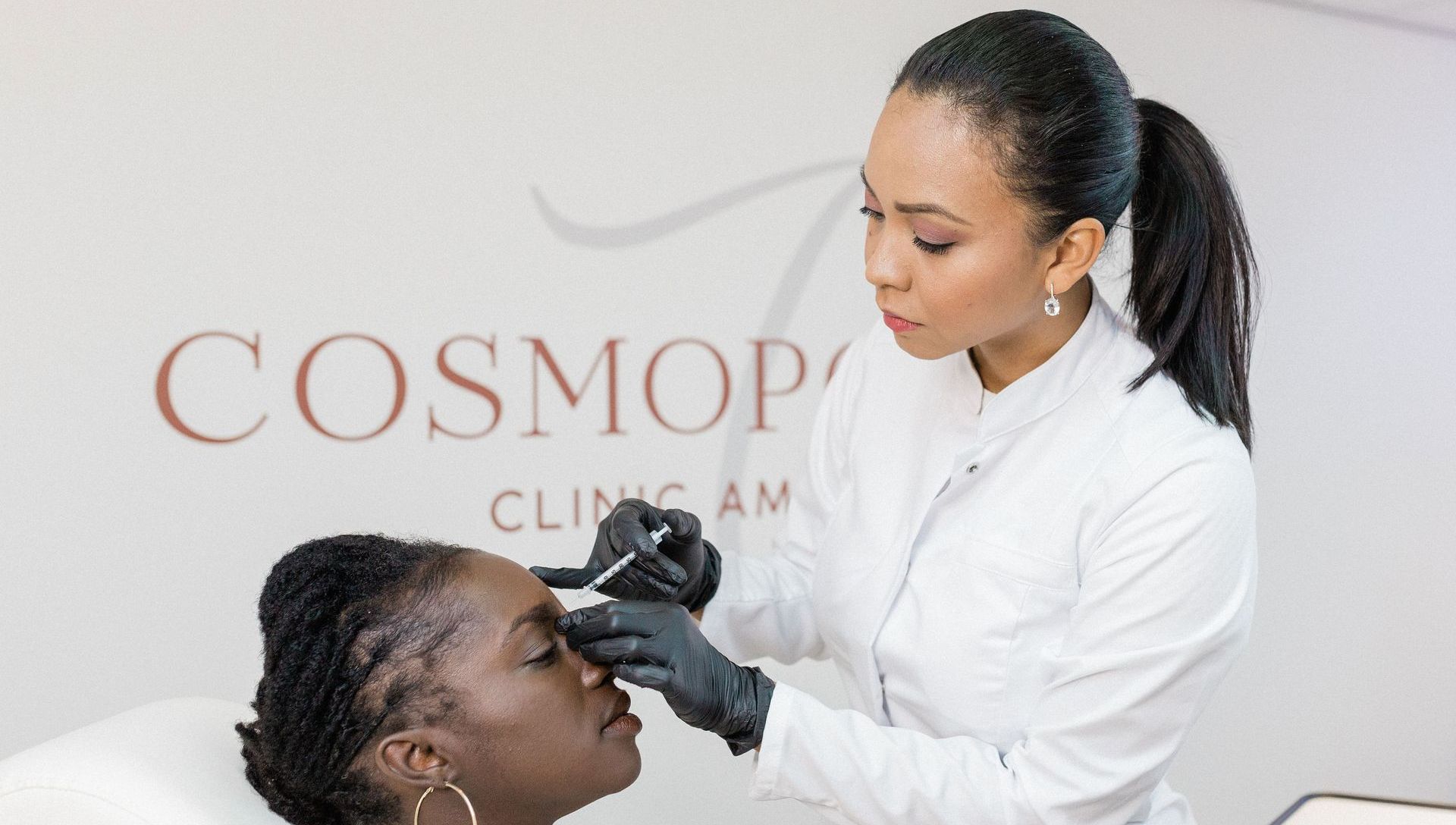
During the treatment, the doctor injects botulinum toxin into the muscle. The product temporarily blocks the signal from the nerve to the muscle. The muscle contracts with less force and, because it is used less, becomes smaller after a few weeks. So slimming the jawline is not an immediate effect, but the result of a muscle temporarily having less to do.
There is now reasonably strong evidence that it works. A 2026 meta-analysis pooled five randomized, placebo-controlled studies with a total of 536 participants. The researchers found that botulinum toxin reduced masseter muscle thickness and visible prominence in the short term, with higher satisfaction than placebo. They did note, however, that results varied considerably between studies and that the optimal dose has yet to be established. In a large series from 2005 involving 1,021 treatments, 383 people were followed for at least three months. After three months, their muscles were an average of 31 percent thinner on ultrasound, and most noticed the effect after two to four weeks.
Because the treatment targets a large, strong muscle close to other facial muscles, its side effects are distinctive. They’re only partly similar to what you might experience with forehead wrinkle treatment.

Reduced chewing strength: the downside many people notice
The most common downside is also the most straightforward: you chew with less force. In the 2018 study by Peng and Peng, 680 patients were followed across a total of 2,036 treatments, with each complaint recorded per treatment. After 611 treatments—30 percent—patients reported a temporary reduction in chewing strength.
In practice, you will notice this mainly with chewy or hard foods: a piece of baguette, steak, nuts or chewing gum. Your jaw gets tired more quickly. You can still eat and talk normally. To be honest, this is not a side effect in the usual sense, but part of how the treatment works. A muscle that is to become smaller first has to work less hard.
For most people, this is bothersome but manageable. If you eat a lot of hard foods, play a wind instrument, or have a job that involves talking a lot for long periods, discuss this beforehand. The dose can be adjusted accordingly.
An uneven or restricted smile
This is the complication that gets the most attention on social media. At the front of the chewing muscle is a thin, superficial muscle that pulls the corner of your mouth sideways when you smile: the risorius muscle. If botulinum toxin reaches or gets very close to this muscle, the smile becomes less broad on that side. This can make your smile look uneven.
The good news is that it’s rare. In the series of 2,036 treatments, a restricted smile occurred three times, or 0.15 percent. A review of 36 publications on side effects of masseter injections concluded that most complications appear within two to four weeks of the injection and resolve within twelve weeks. The same applies here: it’s unpleasant, but it goes away on its own as the treatment wears off.
That doesn’t make it insignificant. Twelve weeks with an uneven smile is a long time if you have a wedding or job interview coming up. The risk is closely linked to where the injections are placed, which we’ll discuss later.
Paradoxical bulging of the chewing muscle
A lesser-known downside is so-called paradoxical bulging. The goal is a slimmer jaw, but when you clench your jaw, a bulge appears in the muscle instead. This happens because not all parts of the chewing muscle have been reached equally. The untreated part remains active and pushes outward while the rest is relaxed.
In the series mentioned, this occurred after ten of 2,036 treatments, or 0.49%. The doctor can assess this at a follow-up and, if needed, adjust it with a small additional injection into the still-active area. This is one reason why a follow-up after a few weeks is useful: it allows the doctor to see whether the muscle has responded evenly.
Hollow cheeks and sagging along the jawline
The masseter muscle doesn’t just provide strength—it also adds volume and support to the lower part of your face. So when the muscle gets smaller, some of that support is lost too. For most people, that’s exactly the desired effect. For some, however, it can have an unwanted effect.
This can happen in two ways. The first is a hollow area just below the cheekbone, making the cheeks look more sunken. This was reported after nine of 2,036 treatments, or 0.44%. The second is sagging along the jawline, known in English as jowls. This was reported after four treatments, or 0.20%. Clinics point out that this risk is mainly relevant for people whose skin has already lost some firmness. There is not yet strong research on this group.
That last point deserves particular attention. Sagging along the jawline is caused by a lack of support, and we wrote earlier in our blog about the difference between jowls and hamster cheeks. If you already have early jowling, a smaller chewing muscle will not automatically be an improvement. That is why a good doctor looks not only at the muscle, but at the entire lower face.

Bruising and headaches
Then there are side effects that can occur with almost any injection. Bruising at the injection site was reported after 51 of 2,036 treatments, or 2.5%. It goes away on its own and can be concealed with makeup in the meantime.
Headaches occurred after twelve treatments, or 0.58%. This side effect is also temporary. If the pain lasts longer or gets worse, contact the clinic where you were treated.
Notably, these minor side effects occur more often in the data than the complications people worry about most. An uneven smile is more than ten times rarer than bruising.
The effect is temporary
One downside that does not appear on any side-effect list is that the results are not permanent. Botulinum toxin works for several months. After that, nerve signals recover, the muscle starts working harder again and gradually increases in size. Exactly how long the effect lasts varies from person to person and depends on the dose and how large the muscle is.
If you want to maintain the effect, you will need repeat treatments. This is a recurring expense. At Cosmopolitan Clinic, jaw slimming is listed from 350 euros per treatment. So do not budget for just one treatment, but for repeat treatments for as long as you want to maintain the result.
The temporary nature of the treatment also has an upside. If you are unhappy with the result or experience one of the downsides mentioned, things will return to normal on their own. This makes it a treatment that involves little long-term commitment.
Off-label use: what it means for you
Botulinum toxin is approved for cosmetic use in a limited number of areas, such as certain wrinkles in the upper face. The masseter muscle isn’t one of them. The 2018 literature review therefore explicitly describes masseter treatment as off-label use.
Off-label does not mean that a treatment is prohibited or unsafe. Doctors may use a medicine outside its approved indication if there are good reasons and sufficient supporting evidence. It does mean that the manufacturer has not had the medicine specifically assessed for this use. That is why your doctor should explain beforehand why the treatment is being considered, what the risks are and what alternatives are available. If you do not receive this explanation, ask for it.
What we know about the long-term effects
A lot is known about the short-term effects. Much less is known about the effects of repeated treatments over many years. This is an honest downside of the treatment, and we have summarized what can be said.
A 2026 systematic review looked at what happens to the chewing muscle itself after botulinum toxin treatment. It found 14 relevant studies, only two of which were in humans and 12 in animals. The muscle became thinner, muscle fibers changed, and recovery was incomplete in some studies. The researchers warn that the data in humans are too limited to draw firm conclusions.
A second point is the bone. Muscles pull on bone, and this load helps keep bones strong. A 2019 review combined animal and human research and concluded that a reduction in chewing muscle size may be associated with bone loss in the lower jaw, including near the jaw joint. The authors believe patients who receive repeated injections into the chewing muscle should be warned about possible bone damage. The extent of this effect in humans and whether it becomes clinically noticeable are not yet clear.
That is no reason to panic, but it is a reason not to have treatments more often or at a higher dose than necessary. Ask your doctor how they manage this, for example by spacing treatments apart.
When your broad jaw isn’t caused by muscle
A downside that is often underestimated is disappointment. The width of the lower face is not determined by the chewing muscle alone. The shape of the jawbone also plays a role, as does the fat under the skin. Botulinum toxin makes a muscle smaller, but does not change bone or fat.
If your wide jaw is mainly due to the bone, you will see little difference after treatment, while still losing some chewing strength. This is a downside you can avoid entirely by having a proper assessment beforehand to determine whether the muscle is really the cause. To do this, a doctor will usually ask you to clench your teeth and feel and look at how large the muscle becomes. If your jaw becomes visibly wider when you clench, the muscle is a factor. If its shape stays the same, a visible result is less likely.
If teeth grinding or jaw clenching is also an issue, the same treatment can serve a dual purpose. Read more on our page about Botox for teeth grinding and jaw clenching. If you want more definition along the jawline rather than less width, jawline filler treatment is a very different option.
How to reduce the risk of side effects
Most downsides of masseter Botox have a clear cause: the product ends up somewhere it should not, or the dose is not right for your muscle. There is a lot you can do to prevent this.
- Choose a practitioner who is a registered physician and experienced in treating this specific area.
- Ask whether the muscle is marked out beforehand while you clench your jaw. Peng and Peng recommend injecting within a safe zone in the muscle, at three to four sites and at least one centimeter from the edges, to avoid important nearby structures such as the muscles around the corners of the mouth.
- It is better to start conservatively and schedule a follow-up than to use a high dose all at once. More can be added, but it cannot be reversed.
- Tell your doctor beforehand if the skin along your jawline is already starting to sag. This changes the decision.
- Do not schedule your treatment right before an important event. Most complications appear in the first few weeks.
With these precautions, the figures are reassuring. The more serious downsides, such as an uneven smile or hollow cheeks, each occurred in fewer than half a percent of treatments in the series of more than two thousand, and they were temporary.

Sources
| Subject | Sources |
|---|---|
| Complications per treatment across 2,036 sessions in 680 patients (chewing strength 30 percent, bruising 2.5 percent, headache 0.58 percent, restricted smile 0.15 percent, paradoxical bulging 0.49 percent, sunken cheeks 0.44 percent, laxity 0.20 percent) and guidance on the safe injection zone. | Peng HP, Peng JH. Journal of Cosmetic Dermatology 2018;17(1):33-38 (published, peer reviewed). |
| Off-label use; most complications appeared within 2 to 4 weeks and resolved within 12 weeks, based on 36 publications. | Yeh YT, Peng JH, Peng HP. Journal of Cosmetic Dermatology 2018;17(5):675-687 (published, literature review). |
| Short-term effect on muscle thickness, prominence and satisfaction, five randomized studies, 536 participants. | Machado GF et al. Journal of Plastic, Reconstructive and Aesthetic Surgery 2026;119:212-225 (published, systematic review and meta-analysis). |
| Muscle thickness decreased by an average of 31% after three months in 383 patients followed (out of 1,021 treatments); the effect was visible after 2 to 4 weeks. | Kim NH et al. Plastic and Reconstructive Surgery 2005;115(3):919-930 (published). |
Frequently asked questions
What are the downsides of Botox in the jaw muscle?
The most common downside is temporarily reduced chewing strength, reported after 30% of treatments in a series of 2,036 treatments. Less common are bruising (2.5%), headache (0.58%), paradoxical bulging (0.49%), hollow cheeks (0.44%), sagging along the jawline (0.20%), and a restricted smile (0.15%). In addition, the effect is temporary, so repeat treatments are needed.
Can you chew normally after masseter Botox?
Yes, you can still eat and talk normally. However, chewing hard or chewy foods may temporarily take more effort, and your jaw may tire more quickly. This eases as the product wears off.
Can masseter Botox change your smile?
It can happen, but it is rare. If the product reaches the small muscle that pulls the corner of the mouth sideways, the smile becomes less broad on that side. In the series mentioned, this occurred after 0.15% of treatments. It goes away on its own, usually within twelve weeks.
Does masseter Botox have long-term side effects?
This has been studied less than the short-term effects. A 2019 review points to possible bone loss in the lower jaw with long-term treatment, based mainly on animal studies supplemented by clinical data. The extent of this in humans is still unclear. That’s why it’s wise not to use higher doses or treat more often than necessary.
How long do side effects last?
According to a review of 36 publications, most complications appear within two to four weeks of the injection and resolve within twelve weeks. Bruising or a headache usually goes away on its own. If a complaint persists or gets worse, contact your provider.
Personal advice
Not sure whether masseter Botox is right for you, or want to find out first whether your wide jaw is actually caused by your chewing muscle? During a personal consultation, the doctor will assess your face at rest and while you clench your jaw, discuss the pros and cons for your situation, and give honest advice if another treatment would be a better fit. Contact us to make an appointment.